
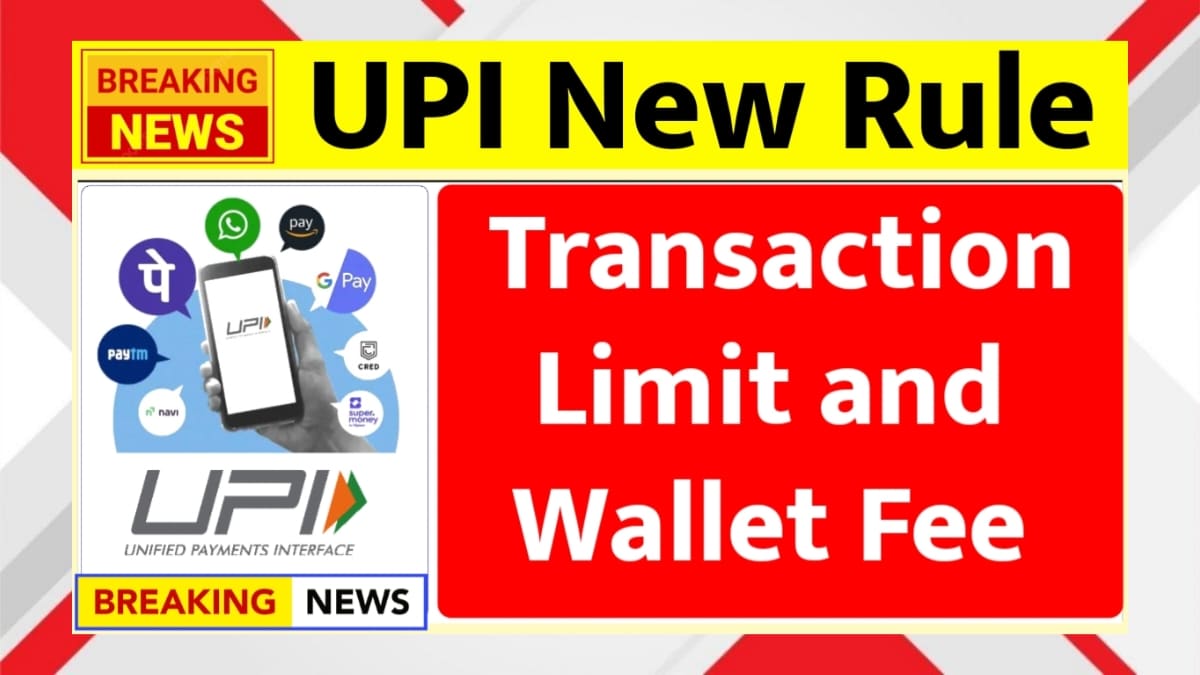
The National Payments Corporation of India (NPCI) has recently announced a new UPI rule for 2025 that will directly impact millions of digital payment users across India. The new update includes changes in the transaction limit, wallet linking system, and small wallet fee structure to make the Unified Payments Interface (UPI) more efficient, secure, and sustainable.
With over 12 billion transactions happening monthly through apps like PhonePe, Google Pay, Paytm, Amazon Pay, and others, these updates aim to streamline digital payments while ensuring better monitoring of high-value transactions.
What is the New UPI Rule 2025
According to NPCI’s new framework, users will now face certain transaction limits depending on the type of payment and platform used. While regular peer-to-peer transfers will continue to remain free, high-value or wallet-based transactions may now attract a small interchange fee to maintain system sustainability.
The UPI transaction limit for a single transaction remains ₹1 lakh for most categories, but for specific sectors like education, healthcare, and mutual funds, the limit has been raised up to ₹5 lakh per transaction. This update is aimed at encouraging digital payments for essential services while keeping the system transparent.
Wallet Fee and Prepaid Payment Rules
One of the major updates includes the wallet linking rule. Starting in 2025, users can link their digital wallets with UPI apps such as PhonePe, Paytm, and GPay to make seamless transactions. However, certain merchant payments made through wallet-linked UPI IDs may include a small wallet fee ranging between 1.1% to 1.5%, depending on the amount and merchant category.
For ordinary users transferring money from bank to bank, there will be no additional fee. The charges apply only to commercial or large-value transactions initiated from wallet-linked UPI IDs.

Transaction Limit Updates for Different Users
- For general users: ₹1 lakh per day limit
- For healthcare and education: ₹5 lakh per transaction
- For small merchants and P2P transfers: Free and unlimited within daily limit
- For wallet-based payments: Limit up to ₹2 lakh depending on the provider policy
These new limits ensure fair usage, reduce fraud, and provide faster settlement between banks and payment apps.
Purpose of the New Rule
The main goal behind the UPI New Rule 2025 is to create a balanced and financially sustainable digital payment ecosystem. With UPI transactions growing rapidly, the new structure ensures security, transparency, and reduced system load while giving users more flexibility through wallet integration.
Conclusion
The UPI New Rule 2025 brings a significant shift in India’s digital payment landscape. While normal users can still enjoy zero-fee transfers, merchants and businesses will experience a more structured payment process through wallet integration and transaction-based limits. These rules are designed to make UPI more future-ready, transparent, and secure for every user.
FAQ
Q1: What is the new UPI transaction limit for 2025
The transaction limit is ₹1 lakh for regular users and ₹5 lakh for healthcare and education payments.
Q2: Will users be charged for sending money via UPI
No, peer-to-peer transfers between bank accounts will remain free.
Q3: What is the new wallet fee in UPI
A small fee of 1.1% to 1.5% may apply to wallet-linked merchant payments above ₹2000.

Q4: Can users link wallets with UPI apps
Yes, wallets like Paytm, PhonePe, and GPay can now be linked directly to UPI IDs.
Q5: When will these new UPI rules come into effect
The implementation will begin gradually across UPI platforms starting from early 2025.


 Join WhatsApp